
A decision-focused comparison for food managers: seven questions to map buyer requirements, know when GFSI FSSC 22000 is needed, and reduce audit risk.

HACCP is a hazard-control method built around seven Codex principles. ISO 22000 is a full food safety management system (FSMS) that absorbs those same principles and wraps them in leadership requirements, prerequisite programmes, and continual improvement. HACCP usually covers local regulatory obligations. ISO 22000, or a GFSI-recognised scheme like FSSC 22000, comes into play once export markets, major retailers, or tender documents demand it.
TL;DR:
- HACCP is limited to hazard identification and control at critical points, while ISO 22000 incorporates leadership, verification, and continual improvement into a full management system.
- GFSI-recognised schemes like FSSC 22000 add sector-specific PRPs, unannounced audits, and stricter surveillance, making them suitable for export markets and major retailers.
- Achieving ISO 22000 or FSSC 22000 typically requires several months, increased costs, and mature documentation practices, especially in internal records and equipment calibration.
- The primary factor influencing certification choice is who your buyers are and whether their contracts or tenders specify GFSI recognition, not simply system technicality.
- Building a solid HACCP foundation before upgrading to ISO 22000 improves internal capability and reduces audit risks caused by weak verification records or uncalibrated equipment.
HACCP is the older, narrower discipline. It was built for one job: identify where a hazard can enter a food product and control it at that exact point. The Codex Alimentarius framework sets out seven principles that every HACCP plan must follow, delivered through a 12-step development process.
HACCP’s strength is its precision at the operational level. It answers, “where can this batch go wrong, and how do we catch it?” It does not, however, mandate a management review cycle, leadership accountability, or a documented improvement loop. That is the trade-off. A small processor selling into local supply chains, a food service operator, or a business that mainly needs to demonstrate regulatory compliance often finds HACCP sufficient on its own.
ISO 22000 doesn’t replace HACCP. It builds a management system around it. The standard follows the Annex SL structure shared by ISO 9001 and other ISO management standards, organised through a Plan-Do-Check-Act (PDCA) cycle across ten clauses covering context, leadership, planning, support, operation, performance evaluation, and improvement.
Two things separate ISO 22000 from HACCP in practice:
ISO 22000 integrates HACCP principles into that broader structure, and adds management responsibilities such as leadership commitment and performance evaluation that a standalone HACCP plan was never designed to carry.
Think of it as a ladder rather than three competing options.
Buyers ask for GFSI recognition specifically because it signals a scheme has been benchmarked against a common global standard, not just self-certified against a generic framework. FSSC 22000 audits also tend to introduce sharper edges: food fraud mitigation, food defence measures, and occasionally unannounced audits that HACCP and plain ISO 22000 certification don’t require.
Once you strip away the acronyms, the decision comes down to seven questions. Where does your buyer sit, and how much system maturity do they expect you to prove?
| Dimension | HACCP | ISO 22000 | FSSC 22000 |
|---|---|---|---|
| Scope / system coverage | Hazard analysis and CCP control | Full FSMS incorporating HACCP | ISO 22000 plus sector PRPs and scheme rules |
| Recognition and buyer acceptance | Regulatory, local supply | Growing acceptance internationally | GFSI recognised, accepted by major retailers |
| Audit rigour and surveillance | Focused CCP verification | Management-system audit, Stage 1/2, surveillance | Adds unannounced components in some cases |
| Continual improvement / PDCA | Not mandated | Core requirement | Inherited from ISO 22000, plus scheme KPIs |
| Prerequisite programmes | Informal or basic | Structured, benchmarked | ISO/TS 22002 series, sector specific |
| Typical implementation timeframe | several months | several months | several months |
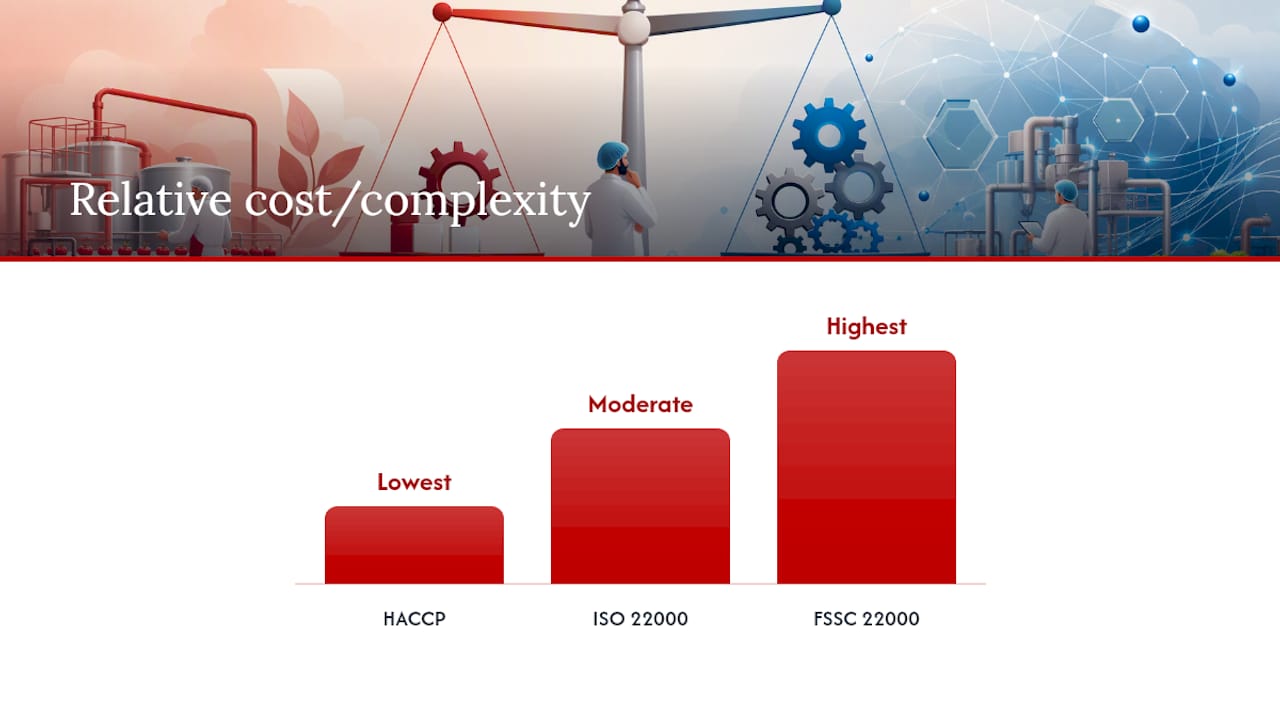
| Relative cost/complexity | Lowest | Moderate | Highest |
Those timeframes come from industry implementation data comparing all three tiers, and they hold up as a reasonable planning baseline for most mid-sized processors progressing from HACCP through to FSSC 22000.
Pro Tip: Don’t assume a bigger certificate always wins the tender. Read the buyer’s specification document first. Many procurement teams write “HACCP-based food safety system” when they mean exactly that, not a full ISO 22000 audit. Chasing unnecessary certification wastes budget you could spend on equipment and calibration instead.
Work through these questions in order before you commit budget to either path.
The staged path works for most small and mid-sized operators: build a solid HACCP foundation, extend it into an ISO 22000 management system once you have leadership and documentation maturity, then add FSSC 22000 scheme requirements only when a specific buyer or market demands GFSI recognition. Jumping straight to the top tier without that groundwork usually just exposes gaps sooner.
Start with a gap analysis mapped directly against ISO 22000’s clauses and the relevant PRPs, not a generic checklist. That tells you exactly which HACCP elements transfer across and which new requirements you’re missing entirely.
The most common reason businesses stumble at audit isn’t a technical HACCP failure. It’s weak verification evidence, incomplete internal audit records, and supplier controls nobody’s been tracking consistently.
Pro Tip: Auditors spend more time reading your records than watching your process. If your temperature logs, calibration certificates, and corrective action reports don’t tell a clean, dated story, no amount of good practice on the floor will save the audit.
Verification records are only as credible as the instruments that produced them. A CCP built around a temperature limit means nothing if the probe reading it hasn’t been calibrated against a traceable standard. We see this constantly: audit findings trace back to a data logger nobody serviced or a scale drifting outside tolerance, not a flaw in the HACCP logic itself. NATA-accredited calibration and clear digital certificates close that gap before an auditor ever asks the question, which is exactly the kind of preventative work a long-established, accredited calibration provider has built a strong reputation around.

For the primary definitions and audit structure referenced here, the ISO 22000 overview from MSC Global is a solid starting point, alongside the certification pathway comparison from IQC Global and the staged implementation guidance at Your Food Safety Guide.
Every CCP, PRP, and verification record in a HACCP or ISO 22000 system depends on equipment that reads accurately and stays accurate between services. Specialist providers offer NATA-accredited calibration, trade verification, and preventative maintenance across scales, moisture analysers, and temperature data loggers used throughout food and pharma operations. If you’re preparing for a Stage 1 or Stage 2 audit and want your monitoring equipment documented and traceable before the auditor arrives, PCS Precision can schedule calibration and issue the certificates your evidence trail needs. Instruments like the Ohaus Ranger 7000 are commonly specified for exactly this kind of CCP monitoring where consistent, traceable readings matter most.
The industry keeps framing HACCP versus ISO 22000 as a technical upgrade path, as though ISO 22000 is simply “better HACCP.” That framing undersells what’s actually happening. The real decision variable is almost never your hazard analysis maturity. It’s who’s asking to see your certificate and what they’ll do with a “no.”
What gets underestimated is how much of an ISO 22000 or FSSC 22000 audit failure traces back to unglamorous things: a data logger that hasn’t seen a calibration certificate in eighteen months, an internal audit schedule nobody actually follows, a corrective action log with gaps. Businesses spend consulting budget perfecting their management review meetings while the CCP verification record underneath it all rests on an uncalibrated instrument. Auditors notice that gap faster than any documentation weakness.
The other overlooked point: staging matters more than most consultants admit. Businesses that skip straight to FSSC 22000 because a single prospective client mentioned GFSI often end up carrying a management system their internal capability can’t sustain past the first surveillance audit. Build the HACCP foundation properly first. Let your documentation habits mature under a system you can actually run before you add scheme requirements on top of it.
— Nima
HACCP is a hazard-control methodology built around seven Codex Alimentarius principles for identifying and managing food safety hazards at critical control points, ISO 22000 is a certifiable food safety management system that incorporates HACCP principles and adds leadership requirements, prerequisite programmes, and a continual improvement cycle.
ISO 22000 is an international standard that gives food businesses a structured management system for controlling food safety hazards across the entire supply chain. It follows the Annex SL / PDCA structure shared with other ISO management standards, covering everything from leadership commitment to performance evaluation.
HACCP itself is a single standardised methodology rather than three distinct types, though it’s applied differently across sectors such as food processing, food service, and retail. The core seven principles and 12-step development process stay consistent regardless of the industry it’s applied in.
No. Good Manufacturing Practice (GMP) covers general hygiene and operational conditions across a facility, functioning as a prerequisite programme, while HACCP is the specific hazard-analysis method that identifies and controls critical control points within that operation.
