
How to commission legal for trade scales in Australia: check the NMI approval, book an NMI licensed servicer, and keep verification certificates.

If you invoice or price customers by weight in Australia, that scale must carry National Measurement Institute pattern approval and be verified by an NMI-licensed servicing licensee before it touches a single transaction. There is no middle ground here. Your immediate move: check the model’s approval number on the nameplate or paperwork, then contact an accredited servicer to book verification as soon as possible if you haven’t already.
TL;DR:
- A scale used for pricing by weight must have an NMI pattern approval number and be verified on-site by a licensed service provider before use.
- Businesses that determine price based on weight, including retailers, weighbridge operators, and precious metals traders, are legally required to use compliant and verified scales.
- Re-verification is needed after repairs, relocations, broken seals, or periods of heavy use, along with regular calibration checks at least once a year.
- Purchasing an approved model and booking verification through the same licensed provider minimizes downtime and ensures ongoing compliance.
- Inspectors can impose fines, seize equipment, and question the legitimacy of transactions based on non-compliant scales, emphasizing proper documentation and maintenance.
“Legal for trade” isn’t a marketing sticker. It’s a two-step legal status, and both steps matter.
First comes pattern approval (sometimes called model or design approval). This is the National Measurement Institute checking that a scale’s design, from its load cell to its display resolution, meets the technical standard for trade use. Without pattern approval, the model can’t legally be used for trade anywhere in Australia, no matter how accurate it tests in your warehouse.
Second is verification, a separate physical step. Once you’ve bought an approved model, it must be verified by an NMI-licensed servicing licensee on-site, where it will actually operate. Verification checks the individual unit, not just the design.
Instrument types covered by this regime include:
Confirm a model’s approval number through the supplier’s documentation or by asking the servicing licensee directly. Never take a supplier’s word for it without seeing the number in writing.
The test is simple: if price changes because of a measurement, you need approved and verified equipment. It doesn’t matter how small the business is or how occasional the transaction feels.
Businesses that always need compliance include butchers and delis pricing by weight, waste and recycling operators charging by tonnage, weighbridge operators, and precious metals dealers. Trade measurement laws apply the moment measurement determines what the customer pays.

Some situations sit in a genuine grey zone. A scale used purely for internal stock checks or portion control, where the customer never sees or pays based on that reading, generally falls outside the requirement. If you’re unsure, verify with business.gov.au or an NMI-licensed servicer rather than guessing.
Run this quick checklist:
Answer yes to any of these, and you need a legal-for-trade scale.
Getting this right is a process, not a single purchase decision. Rushing it usually costs more later in re-verification fees and downtime.
Pro Tip: Combine your equipment purchase and verification booking into a single engagement wherever you can. Coordinating supply and verification through one accredited provider avoids the gap where a scale sits unverified on your counter because nobody scheduled the visit.
Passing verification once doesn’t mean you’re covered forever. Certain events legally reset your compliance status, and missing them is how businesses end up trading illegally without realising it.
Re-verification is required after:
Beyond those triggers, regular calibration checks protect you against gradual drift that pushes a scale outside its tolerance band without anyone noticing until a dispute or inspection flags it. A sensible cadence for most trade-use scales is an annual calibration check at minimum, more often in high-throughput or harsh environments.
Keep a running file of verification certificates, calibration logs, and service records. Re-verification and record-keeping go hand in hand under the rules, and an inspector will expect to see paperwork that matches the physical equipment in front of them. Setting up a standing maintenance contract with an accredited calibration partner turns this from a scramble into a scheduled routine.
Trade measurement inspectors have real enforcement powers, not just advisory authority. They can enter premises, test equipment on the spot, and seize non-compliant scales.
Consequences for getting caught out include:
If an inspector arrives, have your verification certificate and service records ready to show immediately, and be able to explain your maintenance routine in plain terms. The best defence is preventive: keep documentation current, book re-verification the moment a trigger event happens, and never let a scale run past its due calibration date because the shop floor is busy.
Not every technician who touches a scale can legally verify it. Ask direct questions before booking anyone.
Common installation faults that quietly invalidate verification include poor mounting on uneven floors, environmental exposure the model wasn’t rated for, and displays positioned where customers can’t actually read them. Any of these can undo a verification that passed on paper but fails in practice.
Pro Tip: Ask your supplier whether they also hold NMI servicing licensee status. Buying and verifying through the same provider removes the coordination gap that leaves scales sitting idle while two separate businesses schedule around each other.
The biggest misconception in this space isn’t about the law itself. It’s the assumption that a scale labelled “trade approved” is a one-time purchase decision, ticked off and forgotten. In practice, legal-for-trade status is a standing obligation, not a sticker on the box.
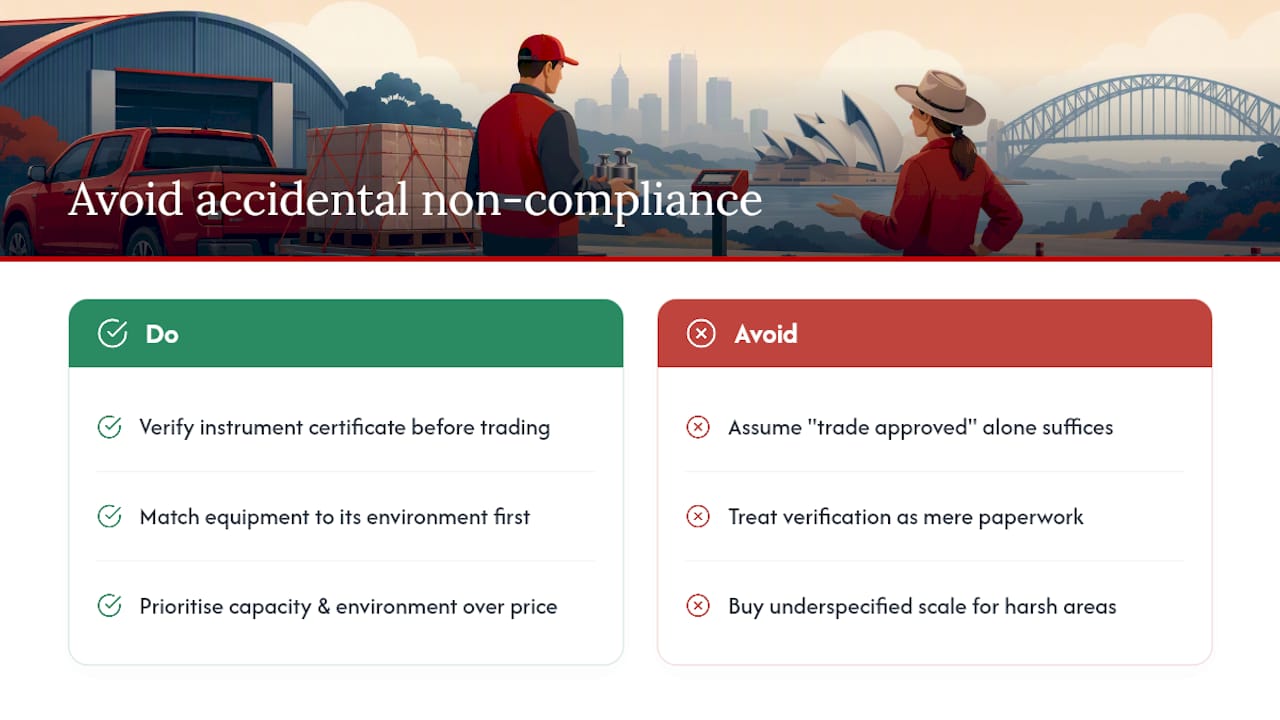
Where I think most operators get this wrong is treating verification as paperwork rather than as the actual gate to legal trading. A scale with pattern approval but no verification certificate is not legal for trade, full stop, yet plenty of businesses assume the approval alone covers them. That gap between “approved model” and “verified instrument” is where most accidental non-compliance happens.
The advice I’d prioritise above everything else: match the equipment to the environment before you buy, not after. A scale under-specified for a dusty loading dock or a wet processing floor won’t just drift out of tolerance faster, it’ll trigger re-verification events more often, and each one costs downtime you didn’t budget for. Choosing on capacity and environment first, price second, is the difference between a compliance program that runs quietly in the background and one that keeps landing on your desk as a fire to put out.
— Nima
A provider that offers NATA-accredited calibration, trade verification, and equipment supply through a single team can help avoid the coordination gap that trips up many operators, preventing the need to buy a scale from one supplier and separately book verification with an NMI-licensed servicing licensee. A typical engagement starts with a site assessment to match capacity and environment to the right model, moves through supply of an NMI-approved instrument, then verification with your certificate issued on the spot, and finishes with an ongoing maintenance plan so re-verification triggers don’t catch you off guard.
That last part matters more than most buyers expect. Repairs, relocations, and broken seals all reset your compliance clock, and a standing servicing relationship means someone is already tracking it. If you’re weighing up options for a new i-TME weighing module or need a straight replacement scale verified fast, get in touch with PCS Precision for a quote or site assessment before your next busy trading period.
For approval numbers, licensing lists, and legal obligations, go straight to the source. The Department of Industry’s trade measurement page covers NMI approvals and enforcement. Business.gov.au’s trade measurement laws page summarises who must comply. The pre-packaged goods guide covers re-verification and record-keeping obligations in detail.
The model needs NMI pattern approval, and the individual unit must then be verified on-site by an NMI-licensed servicing licensee before it’s used for any transaction priced by measurement.
If the price a customer pays depends on a weight reading, yes. This covers retail counters, weighbridges, waste tipping, and precious metals trading, among others.
There’s no fixed universal interval, but re-verification is legally required after any repair, adjustment, relocation, or broken seal, and annual calibration checks are a sensible minimum for most trade-use scales.
They govern the accuracy and approval status of instruments used to determine price, including scales, weighbridges, and indicators, and they give inspectors power to test equipment and issue penalties for non-compliance.
Yes. PCS Precision supplies NMI-approved equipment and provides NATA-accredited calibration and trade verification services, so supply and verification can run through a single engagement.
