
Pick the right moisture analyser for labs & production with a 6 step checklist. Heating method guidance, compliance checks and PCS calibration.

For fast production QC, a halogen loss-on-drying moisture analyser gets you a reliable result in minutes. If your samples are thermosensitive, uneven, or prone to scorching, an infrared or dark-radiator unit gives you gentler control. Where water chemistry specificity matters more than speed, Karl Fischer titration is the right tool. The section below matches each scenario to the method and heating technology that suits it.
TL;DR:
- Halogen moisture analysers are suitable for fast, routine QC testing, providing reliable results within minutes for samples that are not thermosensitive or uneven.
- Choosing infrared or dark-radiator units is better for thermosensitive, uneven, or dusty samples, as they offer gentler heating and better environmental tolerance.
- Proper calibration and validation, including traceable calibration certificates and routine checks, are essential to maintain accuracy and meet GLP/GMP standards over time.
- Match analyser capacity and readability to your sample size and moisture levels, ensuring consistent sample spreading and stable ambient conditions to avoid skewed results.
- Support, spare parts, and calibration services are more critical than initial price, especially in regulated environments where downtime and compliance matter.
Moisture testing splits into a handful of proven method families, and picking the wrong one wastes far more time than reading a spec sheet properly upfront.
Loss-on-drying (LOD) moisture analysers combine a precision balance with a heating chamber. They weigh the sample, heat it, and weigh it again once mass loss stabilises, delivering a result in minutes rather than hours. This makes them the default choice for routine QC where speed and repeatability matter more than absolute chemical certainty.
Drying ovens use the same principle over a much longer cycle, often overnight, and remain the reference method many industries calibrate against. They’re slower but tend to be more forgiving on sample uniformity.
Karl Fischer titration measures water content directly through a chemical reaction, making it the go-to when a sample contains volatile solvents or compounds that would evaporate alongside moisture and skew a weight-loss result.
Near-infrared (NIR) screening doesn’t dry the sample at all. It estimates moisture from spectral absorption, which suits high-throughput, non-destructive screening but needs calibration against a reference method first.
Heating technology is arguably the single biggest decision in this whole process, because it determines how fast you get a result and whether that result actually reflects the sample.
Sample colour, particle size and volatility should drive this choice more than price. A dark, dense powder absorbs halogen heat unevenly; a pale, fibrous material might dry faster under infrared than expected. Heating technology shapes speed, repeatability and sample integrity more than almost any other spec on the datasheet.
Pro Tip: Run a side-by-side trial with your actual production sample, not a reference standard, before committing to a heating technology. Two units with identical specs can produce different results on the same batch once particle size and colour come into play.
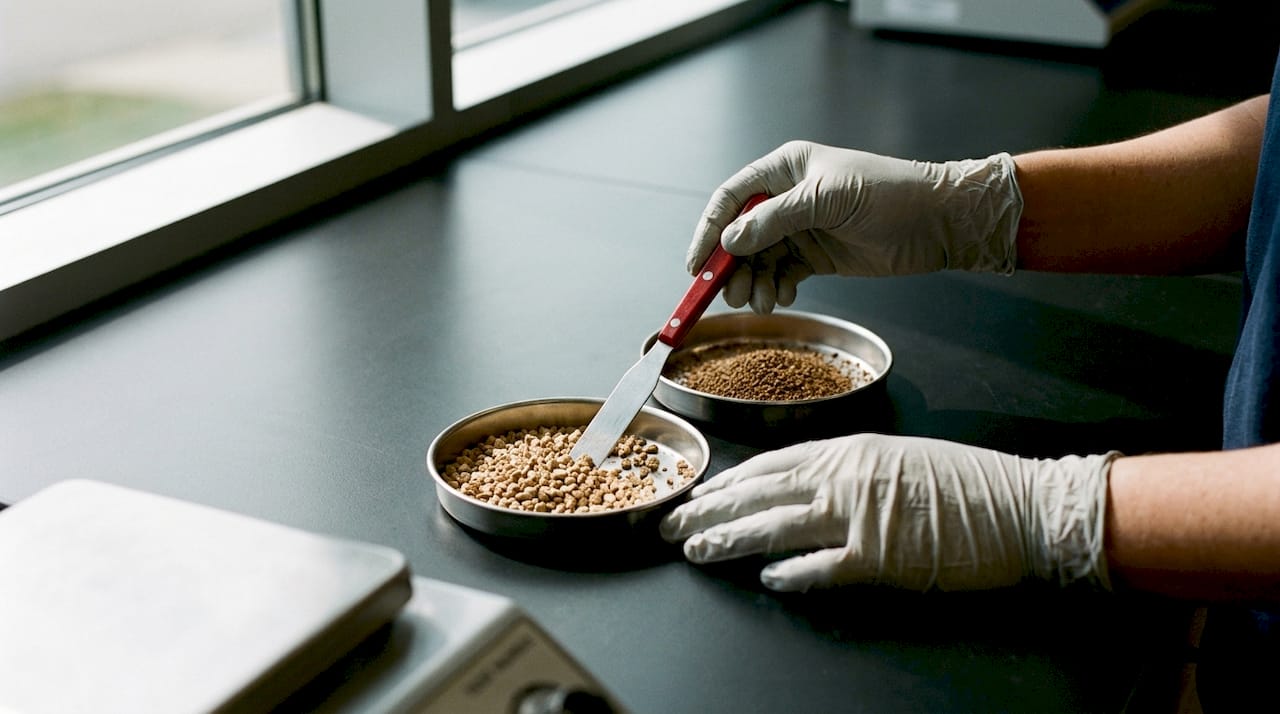
Instrument specifications only mean something once you match them against your real sample mass and expected moisture range.
Capacity and readability need to fit the job, not the brochure. Typical benchtop units offer 50 to 200 grams of capacity with readability down to 0.001 grams, and most sample weights sit between 2 and 10 grams depending on density and how the material dries. Oversized samples slow drying and distort results; undersized samples on a low-readability balance introduce noise you’ll chase for weeks.
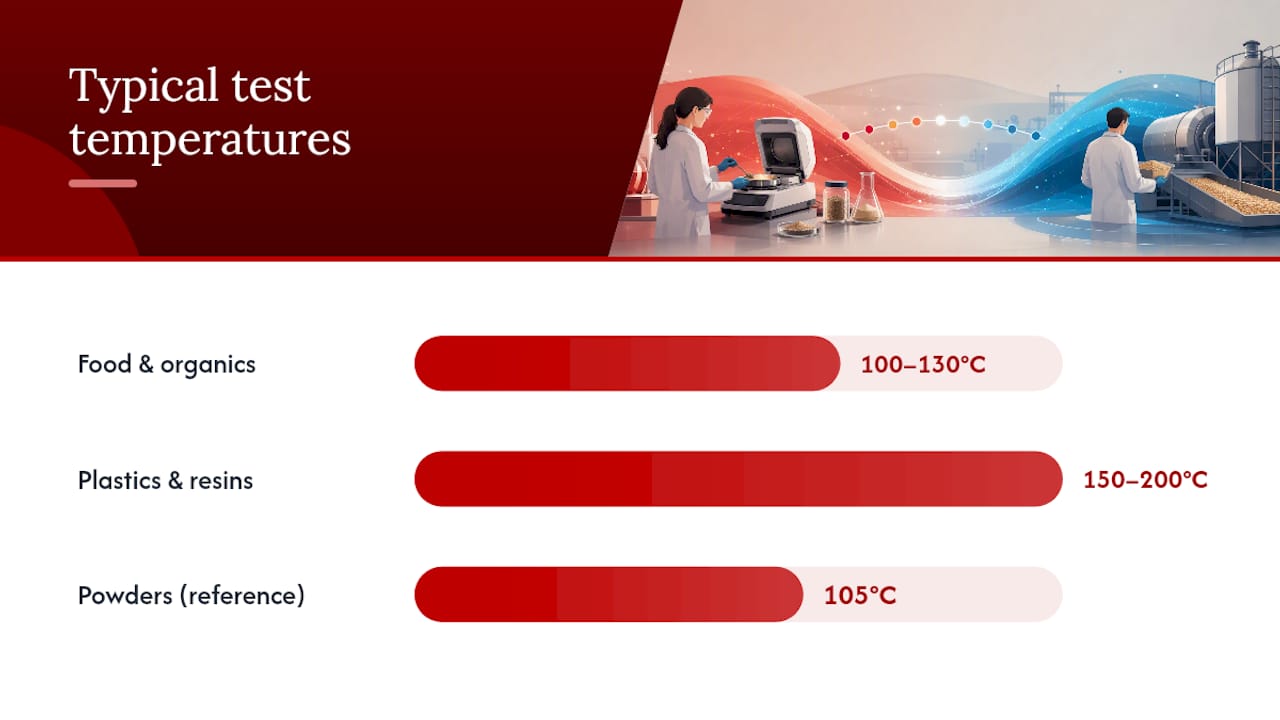
Temperature range and ramp control matter just as much. Most analysers span 40°C to 200°C, with premium units reaching 250°C. As a rough baseline, food and organic samples usually sit around 100 to 130°C, plastics and resins need 150 to 200°C, and powders are often tested against a 105°C reference point.
None of the specs above matter long term if the instrument drifts and nobody catches it. Calibration and validation are what keep a moisture analyser trustworthy between the day it’s installed and the day someone audits your QA file.
Manufacturers now build guided workflows and traceable reporting directly into analysers, including operator logs and interfaces like USB, RS-232 and Ethernet for archiving results against GLP and GMP requirements.
These features map straight onto audit questions. If an inspector asks how you know a result wasn’t edited after the fact, “the report is non-editable and timestamped” is a much better answer than “we trust our staff.” Regular calibration intervals protect both your data and your accreditation status.
Work through this in order rather than jumping straight to specs, because throughput and sample behaviour should decide the method before you even look at heating technology.
Ask any vendor these questions directly: What’s the calibration interval and can you provide traceable certificates? Are spare heating elements and pans stocked locally, or on backorder from overseas? Does the reporting format satisfy GLP or GMP without a third-party workaround?
Red flags worth walking away from include vendors who can’t explain their calibration process clearly, units with no local service support, and pricing that excludes pans, consumables or software licences.
Pro Tip: Ask for a demo using your own sample, not the vendor’s standard reference material. A dark radiator unit that looks perfect on a demo powder can behave very differently on your actual product.
Brand and price tier also change what you’re really buying. Entry-level units cover basic LOD testing fine, while higher-end analysers add automated performance checks and tighter compliance features that matter more in regulated settings than in a general workshop.
Choosing the right method and heating technology is only half the job. Keeping it accurate over years of use is the other half, and that’s where accredited calibration and multi-brand servicing earn their place.
Understanding NATA calibration standards helps clarify exactly what “traceable” should mean on your certificate before you sign off on any supplier.
The biggest mistake I see is teams chasing the lowest purchase price on a moisture analyser while ignoring who services it. A $2,000 saving upfront means nothing if the unit sits idle for three weeks waiting on a spare heating element. Favour support and calibration access over sticker price, especially in regulated work.
— Nima
PCS Precision helps simplify your moisture analyser purchase by providing calibration, multi-brand support, and preventative maintenance from one team familiar with halogen, infrared and dark-radiator technology. If you’ve landed on a method family from this guide but need help narrowing the right model, browse the current range of balances, scales and measuring equipment, or go straight to booking a calibration or service quote so your new instrument stays audit-ready from day one.
A moisture analyser is a lab instrument combining a balance and heater to measure precise moisture percentage by weight loss. A moisture meter is typically a portable field device giving a quick estimate, useful for spot checks rather than regulated reporting. PCS Precision compares the two in detail for lab buyers weighing up which fits their workflow.
Choose halogen for general QC where speed and even heating across a range of samples matter most. Choose infrared when your samples are thermosensitive, thin, or prone to scorching under fast, intense heat.
Mass and temperature calibration should happen on a routine schedule set by your quality system, plus immediately after any relocation or heavy use spike. PCS Precision’s NATA-accredited calibration service covers both checks with traceable certification.
Not reliably. Samples that melt, char or contain volatile solvents often need a different method, such as Karl Fischer titration instead of standard loss-on-drying. Most labs running varied materials keep more than one method available.
Pricing depends on the instrument, its condition and the calibration scope required, so current rates are available directly on the PCS Precision calibration service page.
