
What an insulation resistance tester measures, how to test safely, which readings AS/NZS 3760 expects and how to keep the instrument calibrated in Australia.

An insulation resistance tester (also called a megohmmeter, or “megger” after a well-known brand) applies a DC test voltage across electrical insulation and measures how much current leaks through it. The result, in megaohms, tells you whether cable, motor windings or switchboard insulation is still doing its job. The number is only as good as the instrument that produces it, so the tester needs a calibration record you can show an auditor, and that is where we come in. At PCS Precision we are NATA accredited and ISO 9001 certified, and we calibrate on-site or in our workshop, so a tester that drives your maintenance decisions stays traceable.
This guide covers what the tester does, how to choose one, how to run a test safely, which readings Australian standards expect and how to keep the instrument itself accurate.
Insulation is meant to stop current going where it should not. Over time heat, moisture, contamination and mechanical stress wear it down. An insulation resistance tester puts a known DC voltage across the insulation and measures the very small current that leaks through. It then calculates resistance using Ohm’s law, resistance equals voltage divided by current. RMIT’s electrotechnology training material describes the result in megaohms and lists its uses: preventive maintenance, diagnosing circuit faults and checking insulation against specifications on conductors, motors and switchboards.
Three points matter for a plant or lab manager:
Note that the Queensland code is a state document. It is a useful benchmark for good practice, but check the rules and regulator in the state where your site operates, including New South Wales.
The terms overlap. In practice a megohmmeter does the high-resistance measurement and little else, while a modern insulation tester often adds continuity checks, voltage selection and data recording. For purchasing, the name matters less than the voltage range, the resistance range and whether it records results you can trend.
The Queensland code expects an instrument suited to the test’s function, operating range and accuracy, in good condition, with protection against testing hazards. Work through these questions before you buy or hire.
If your site also needs scales, balances, thermometers, data loggers or other metrology tools, our equipment range and calibration services sit under one roof, which keeps your instrument register in one place.
Insulation testing puts a deliberately high voltage on equipment, so the procedure matters as much as the instrument. The Queensland Electrical Safety Office says people testing in-service equipment must have the knowledge and skills to carry out insulation-resistance testing and interpret results in accordance with AS/NZS 3760. Treat that as the baseline for your own people, wherever your site is.
A sound routine looks like this.
There is no single universal number. The right figure depends on the equipment, its voltage rating and the standard you work to. For in-service equipment in Australia, the reference is AS/NZS 3760:2022.
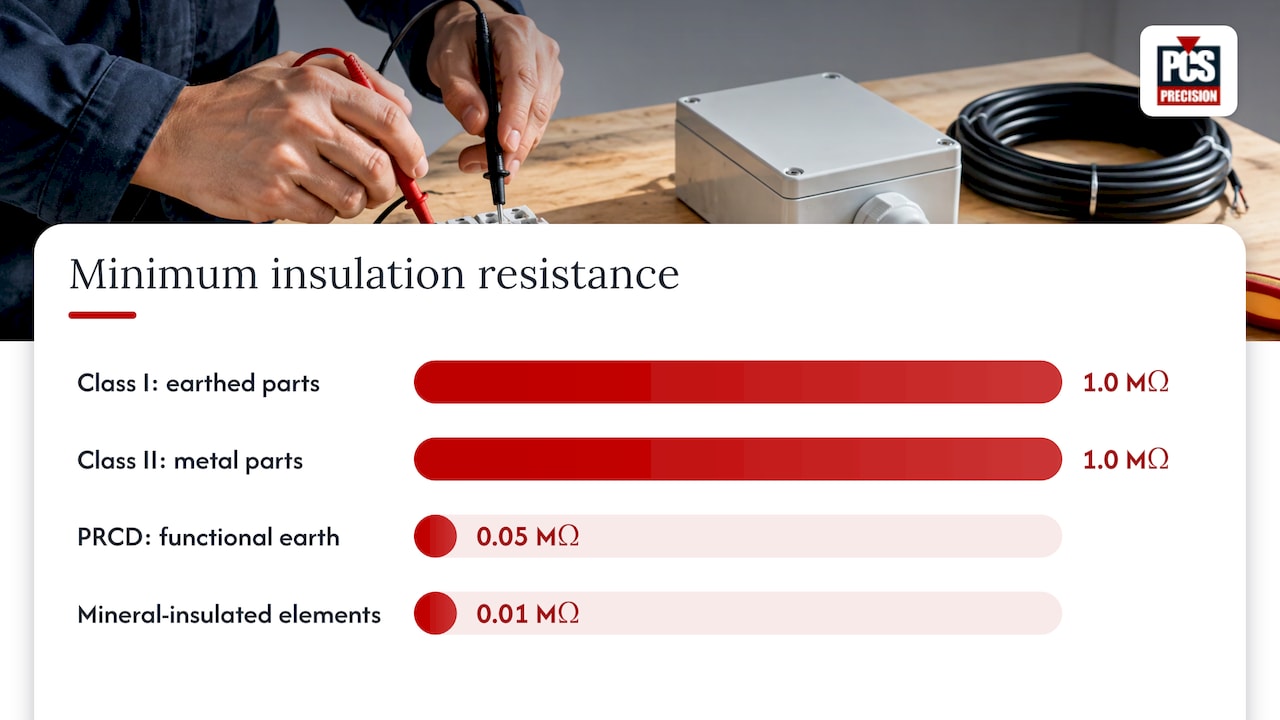
According to AS/NZS 3760:2022, Table 2.2 sets these minimums:
| Equipment | Minimum insulation resistance |
|---|---|
| Class I equipment (live parts to accessible earthed parts) | 1.0 MΩ |
| Class II equipment (live parts to accessible metal parts) | 1.0 MΩ |
| PRCDs with functional earth | 0.05 MΩ |
| Class I equipment with mineral-insulated metal sheath heating elements | 0.01 MΩ |
The standard specifies a test at 500 V DC, and 250 V DC for equipment containing MOVs (metal oxide varistors, which are surge protection components) or EMI filters that bridge the insulation. It was approved in June 2022 and carries Amendment 1 from December 2022.
The standard also sets requirements for the meter itself. Appendix E calls for a measuring circuit isolated from earth, a nominal measuring voltage of 500 V DC and accuracy of Class 5 or better, which means within 5% of full-scale deflection. That is the point where calibration stops being a formality. If your tester drifts outside its stated accuracy, a borderline 1.0 MΩ reading can pass when it should fail, or the reverse.
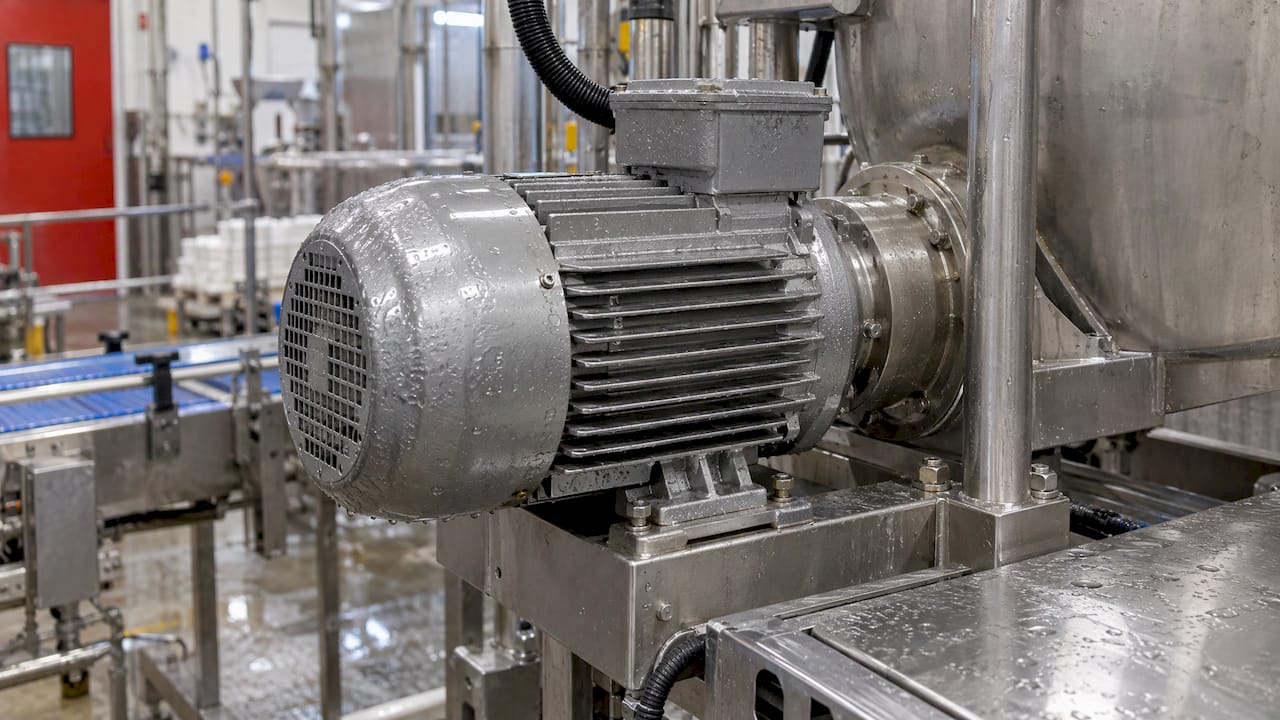
A packaging line has a Class I mixer motor housing tested at 500 V DC. The tester reads 0.8 MΩ. That is under the 1.0 MΩ minimum, so the item fails and comes out of service until the cause is found. Moisture after a washdown is a common suspect. If the instrument had been reading 20% low because it was overdue for calibration, a true reading of 1.0 MΩ would still be borderline. Neither the pass nor the fail can be defended without the calibration certificate, which is why the instrument record belongs in your quality system.
A single reading above the minimum tells you the insulation is acceptable today. A series of readings tells you where it is heading. Record each test with its conditions, and compare against the previous result for the same asset. Moisture, contamination, temperature, humidity and the applied voltage all change the reading, so consistent test conditions make the trend meaningful. A steady fall across several tests flags deterioration well before a trip or a failure stops production.
The test intervals for your equipment and the calibration interval for your tester are two separate questions.
Equipment test intervals. AS/NZS 3760:2022 requires equipment to be inspected and tested at the intervals in its Table 2.4 (with a two-week tolerance), or as varied by a responsible person on the basis of risk. Organisations with enough expertise may set other periods after a documented risk assessment under AS/NZS ISO 31000, but that option does not apply to equipment offered for hire.
Tester calibration interval. WorkSafe Queensland’s guidance says equipment used to measure insulation resistance should be tested regularly to confirm it is working correctly, with the frequency reflecting use, environment and manufacturer advice. In practice that gives you three inputs:
Once you hold a few certificates, the as-found data (how far the instrument had drifted when it came in) lets you shorten or extend the interval with evidence. Our guides on risk-based versus manufacturer calibration intervals and on why regular calibration is critical for industrial accuracy set out that reasoning. For a broader view of calibrating lab equipment and choosing an interval, that technician’s guide is also worth a read.
In food, pharmaceutical and aerospace settings, an auditor will usually ask for the same things on any measuring instrument:
Build these into the instrument register when you buy the tester, and the audit question becomes a document you already hold.
We are a NATA-accredited, ISO 9001 certified Australian company with over 40 years of experience in measurement, calibration and equipment sales. Our NATA calibration and traceable calibration services are delivered on-site or in our workshop, and we support multiple equipment brands regardless of where the instrument was bought. We also provide preventative maintenance, repairs and equipment hire, and we offer 24/7 emergency support for businesses that cannot afford unplanned downtime.
For manufacturers, laboratories and food and pharmaceutical sites, that means the instruments behind your quality decisions can be managed with one provider and one set of records. Browse our calibration service page or contact us with the instruments on your register, and we will tailor a quote to your business.
Most plants we speak to treat the insulation tester as the instrument that checks everything else, and so nobody checks it. That is the gap. A tester’s reading drives decisions about motors, cabling and switchboards, and an instrument that has drifted turns a careful test routine into a record that cannot be defended.
Our view is simple. Put every measuring instrument, electrical or otherwise, on one register with a due date, a certificate and a reason for its interval. Choose accredited, traceable calibration so that the paperwork stands up when the auditor asks. Use as-found results to tune the interval instead of guessing it.
We built PCS Precision around that discipline: NATA accreditation, ISO 9001 certification, on-site and workshop calibration, support across multiple brands and round-the-clock emergency support. The aim is to reduce unplanned downtime and keep your quality standards intact, so you spend time running the plant rather than chasing certificates.
Kaz
It checks whether electrical insulation is still effective by applying a DC test voltage and measuring the leakage current. Maintenance teams use it for preventive maintenance, fault diagnosis and for confirming equipment is safe to return to service after repair or alteration.
It depends on the equipment and the standard. Under AS/NZS 3760:2022, Class I and Class II in-service equipment must read at least 1.0 MΩ when tested at 500 V DC. Plant such as motors and switchgear may be held to other criteria, so follow the specification for the asset and trend the results.
It is commonly called an insulation tester or a megohmmeter, and often a “megger” after a well-known brand name. A megohmmeter usually performs only the high-resistance measurement, while an insulation tester may add continuity, recording and other functions.
WorkSafe Queensland says the instrument should be checked regularly, with the frequency reflecting use, environment and manufacturer advice. A tester used daily in a harsh plant environment needs a shorter interval than one used occasionally in a lab. As-found data from past calibrations gives you the evidence to adjust it.

